24-07-2026
A Digital Marketing Agency in Delhi can offer ten different services in the first meeting. That does not mean a business needs all ten.
Most owners come to us with the same sentence: “We need more leads.”
Fair enough. But that still does not tell us what needs fixing.
Sometimes the company is almost invisible on Google. Sometimes people are visiting the website but leaving without calling. In other cases, ads are already bringing enquiries, yet nobody from the sales team replies on time. We have also seen brands posting regularly on social media without building any real recall.
All four businesses may say they need more leads. Their actual problems are completely different.
So before discussing a package, budget, or monthly plan, the first job is to find the leak.
More Marketing Is Not Always The Answer
It is easy to assume that low sales mean low marketing.
That is not always the case.
Imagine a service company running Google Ads. The campaign gets clicks, but the landing page opens with a vague headline, a long block of text, and no visible call button. There are no client examples, no clear location details, and no reason to trust the business.
Increasing the ad budget will not fix that page. It will only pay for more people to leave it.
Now take another business. Its website is clear, mobile-friendly, and easy to contact. The offer is strong too. But the site appears only when someone searches the company’s exact name.
That business probably does not need another redesign. It needs better search visibility.
This is why we do not believe every problem should be answered with “run ads” or “do SEO.” The service should follow the diagnosis.
When SEO Should Come First
SEO deserves priority when the right people are searching, but your business is missing from the results.
This happens often with local service companies, manufacturers, clinics, consultants, and training institutes. They may rank for the brand name because Google already knows the website. However, they remain absent for searches linked to their actual services.
There is a big difference between someone searching for your company name and someone searching for a solution.
The first person already knows you.
The second person is still deciding whom to contact.
That second group is where SEO can create new demand.
Before starting, though, the website needs a proper review. We often find businesses asking for blogs when their main service pages are thin, unclear, or targeting the wrong search intent. Publishing more content on top of weak pages rarely fixes the core problem.
SEO may need technical work, stronger service pages, better internal links, local optimisation, clearer page structure, or content based on real customer questions.
Not every business needs all of it at once.
When Paid Ads Make More Sense
Paid ads are useful when time matters.
A new course is launching next month. Admissions are open. A seasonal service has limited demand. A business wants to test a new offer before investing in long-term SEO.
In these situations, waiting months for organic traffic may not be practical.
Still, ads need something solid to work with.
The offer must be easy to understand. The landing page should answer the obvious doubts. Contact should take one or two steps, not six. Someone must also be ready to reply when the lead arrives.
That last part gets ignored a lot.
A campaign may deliver a genuine enquiry at 11:00 a.m. The business replies at 5:30 p.m. By then, the person has contacted three competitors.
Later, the conclusion is: “The leads were bad.”
Maybe. But sometimes the lead was fine and the response process was not.
A responsible agency should be willing to say this instead of quietly increasing the campaign budget.
When Social Media Is The Missing Piece
Some businesses are visible but forgettable.
Their Instagram page is active. Posts go out every week. The designs look decent. Still, customers do not remember the brand.
Regular posting and brand building are not the same thing.
A page filled with festival greetings, stock images, generic quotes, and repeated sales posts may stay active without becoming useful.
People remember content that gives them something.
A useful explanation. A clear opinion. A familiar visual style. A real customer problem. A behind-the-scenes look at how the work is done. Even a simple post can build recall when it sounds like the brand and not like every competitor.
Social media should become a priority when people need more confidence before buying. It is especially useful for businesses where the decision takes time.
Someone may not need a designer, battery supplier, consultant, or marketing agency today. But if they have seen useful content from the brand for two months, that name has a better chance of coming back when the need appears.
That is the real work of social media.
When The Website Is Holding Everything Back
A website can receive visitors and still fail the business.
We see this when ads are getting clicks, Search Console shows growth, and people are visiting service pages—but calls and enquiries remain low.
Usually, the issue appears within the first few seconds.
The visitor cannot tell what the company does. The headline sounds impressive but says nothing. The page is difficult to use on mobile. The WhatsApp button is missing. The form asks for too much information. There is no proof that the business has handled similar work before.
Visitors rarely sit down and analyse these problems.
They simply leave.
A full redesign is not always needed. Sometimes the business only needs clearer service pages, better mobile spacing, stronger calls to action, faster loading, or more believable proof.
But there are cases where the website has become a patchwork of old content, broken layouts, and outdated offers. Then rebuilding it may be more sensible than repairing one section every month.
Branding May Need Attention Before Promotion
There is another problem that often hides behind weak marketing: the business itself is not clear about what it wants to say.
The website speaks to one audience. Social media speaks to another. Ads use a third offer. The Google Business Profile still shows old information. Even the sales team describes the service differently from person to person.
That confusion reaches the customer.
Branding, in this situation, is not about making a prettier logo. It is about deciding what the company does best, who it wants to serve, and why someone should believe it.
Once that becomes clear, the rest of the work becomes easier.
SEO pages stop trying to target everyone. Ad messages become sharper. Social media gets a recognisable voice. Sales conversations also become more consistent.
Without that clarity, every channel pulls in a different direction.
What We Check Before Suggesting A Plan
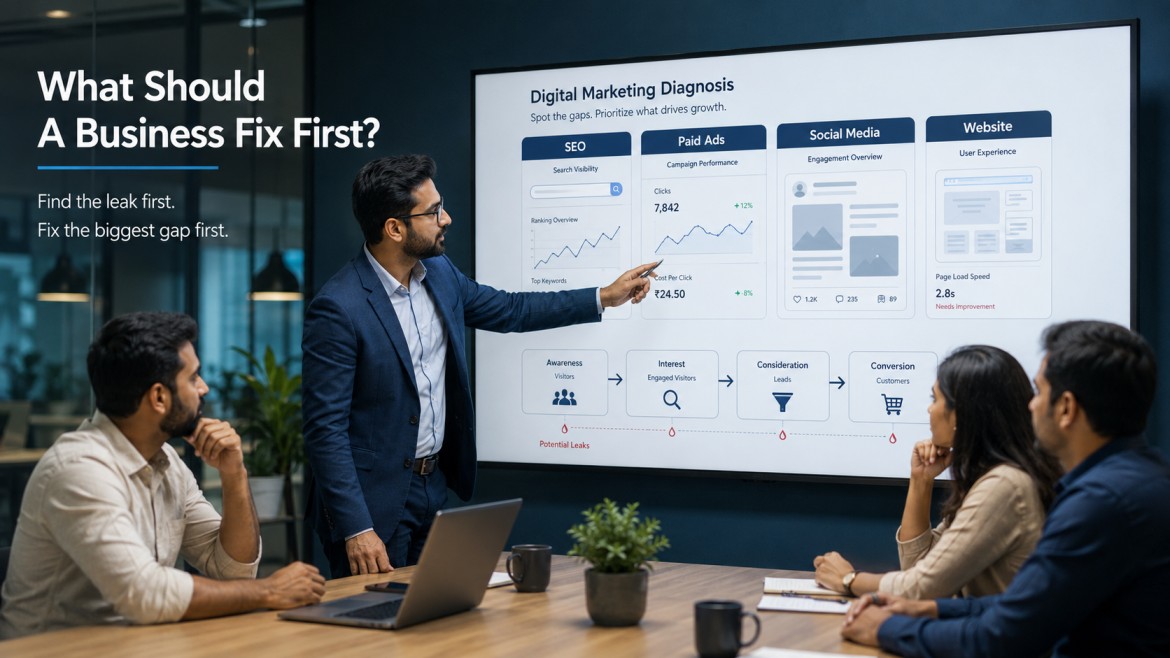
At Digilinkers, we usually look at the whole journey before deciding what should come first.
Can people find the business?
When they find it, does it look trustworthy?
Can they quickly understand the offer?
Is contacting the company easy?
Are the enquiries relevant?
What happens after the enquiry arrives?
One weak stage can cancel out the work done everywhere else.
A company may need SEO because it has no non-branded visibility. Another may need a better landing page before spending on ads. A third may already be getting enough leads but need a stronger follow-up process.
This is also why we prefer a focused 90-day plan over doing everything at once.
Trying to run SEO, redesign the website, post daily, rebrand the company, and launch ads within the same small budget often creates half-finished work in every area.
Fix the biggest gap first. Then move to the next one.
Final Thoughts
There is no universal order that says SEO comes first, ads come second, and social media comes third.
The correct order depends on where the business is losing customers.
No visibility? Work on discovery.
Traffic but no enquiries? Fix the website or offer.
People know the brand but do not remember it? Improve social media and positioning.
Need results quickly? Prepare the foundation and use paid ads.
Leads are already arriving but not converting? Look at the sales process before buying more traffic.
The question is not, “Which digital marketing service is best?”
The better question is, “What is stopping the next customer from finding us, trusting us, or contacting us?”
That answer usually tells us where to begin.
Frequently Asked Questions
1. Should A New Business Start With SEO Or Paid Ads?
It depends on urgency. Paid ads can test demand and bring quicker visibility. SEO takes longer but builds more stable organic reach.
2. How Can I Tell If My Website Is Causing Low Conversions?
Check whether visitors understand the offer quickly, trust the business, find contact options easily, and get a good mobile experience.
3. Does Every Business Need Social Media?
Not every business needs daily posts. However, a credible and useful social presence can support trust, recall, and customer research.
4. Why Do Ads Bring Clicks But Few Enquiries?
Common reasons include weak offers, poor landing pages, wrong targeting, low trust, confusing forms, and delayed responses.
5. What Should A Digital Marketing Agency In Delhi Review First?
It should review visibility, website experience, offer clarity, lead quality, conversion tracking, and the way enquiries are handled.
6. How Does Digilinkers Decide Which Service A Business Needs?
Digilinkers studies the business goal, audience, website, current traffic, enquiries, competition, and sales process before suggesting the first priority.